


Sewn fabric molds offer a lighter route to making concrete beams
A three-meter prototype used much less concrete and steel than a conventional comparison design, but further structural testing remains ahead.
How this story was made
This story was written with AI assistance from MIT News’s source documents. Its figures and quotations were checked against their sources, and Digitalage Desk reviewed and approved it before publication. It is published under the name of Peter Michaels, Editor.
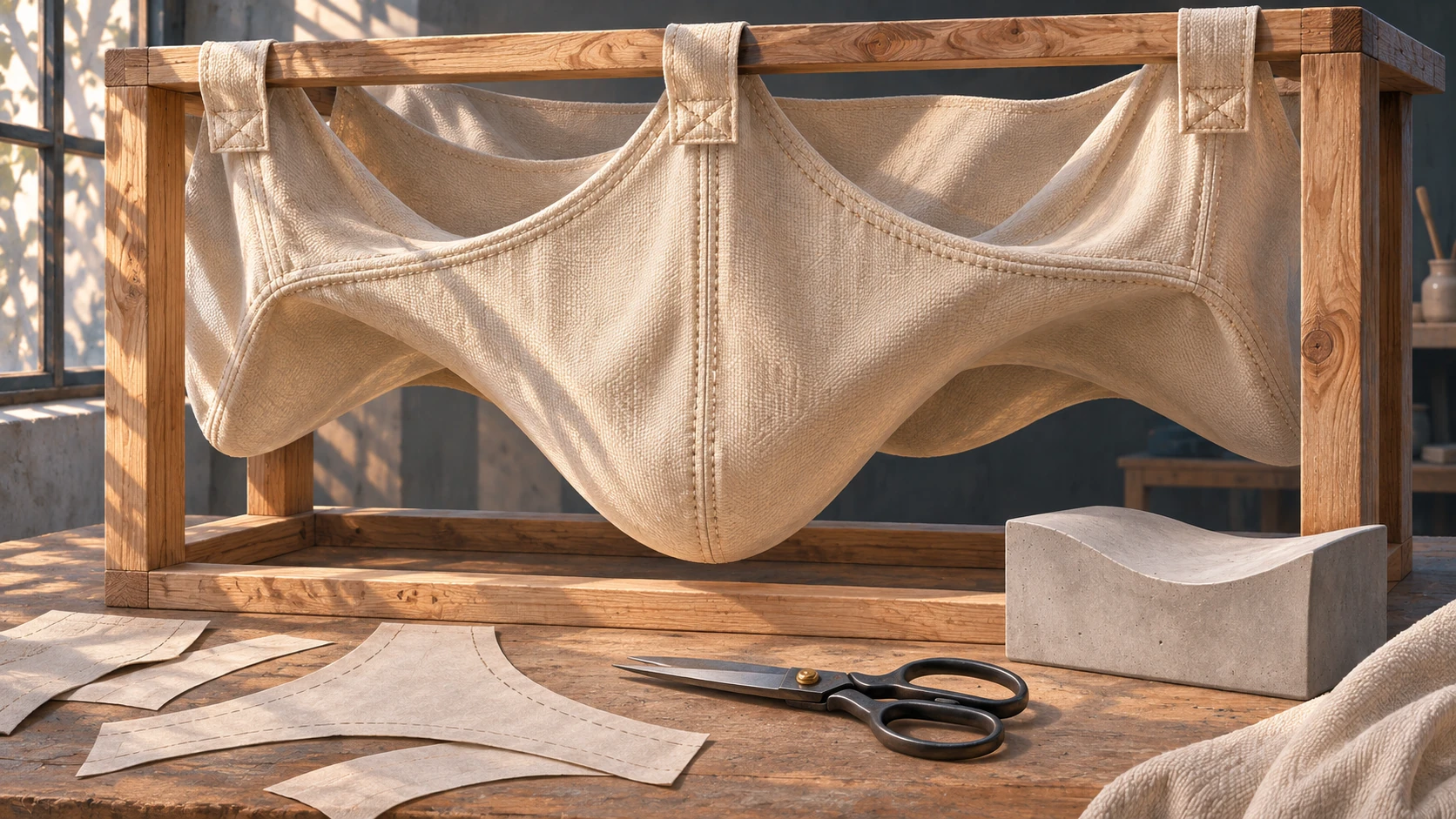
A sewing pattern could help builders make concrete shapes that ordinarily require expensive molds. MIT researchers described on November 6 a method for casting an intricate beam in cotton fabric, supported by a simple timber frame, as a way to reduce construction’s demand for materials.
The team combined a method for laying out steel reinforcement with computer optimization that places concrete where it contributes to the structure. Software then translated the shape into flat pieces of cloth. Sewn together, those pieces became a flexible mold designed to account for deformation under wet concrete.
The research abstract published by the authors’ laboratory reports a three-meter beam using 67.2% less concrete and 52% less steel than a conventional rectangular beam designed for the same load. That comparison concerns one engineered design; it does not establish that every beam or building could achieve those reductions.
The researchers compared molds with different numbers of fabric panels and used three-dimensional scans to assess how closely the finished shapes matched the design. More seams improved control over small details without necessarily improving the shape overall. Precision therefore depended on how the pieces worked together, rather than simply adding more stitching.
Primary sourceMIT News: “Fabric molds could bring material-saving concrete beams within reach”For the physical test, MIT says researchers loaded one of the three cast beams to about 30% of its design load, using water-filled buckets. Its midpoint bending matched the computer prediction within about 2%. This was a service-level check, not a test to failure or proof of its ultimate capacity.
Failure testing comes next. Larger versions require new design work, leaving the method at the prototype stage as researchers examine how far sewn molds can go.
End of story