


NASA’s COSI telescope moves toward assembly and an August 2027 launch
A gamma-ray instrument built to trace antimatter and exploding stars has reached Virginia for installation on its spacecraft and environmental testing.
How this story was made
This story was written with AI assistance from NASA’s source documents. Its figures and quotations were checked against their sources, and Digitalage Desk reviewed and approved it before publication. It is published under the name of Peter Michaels, Editor.
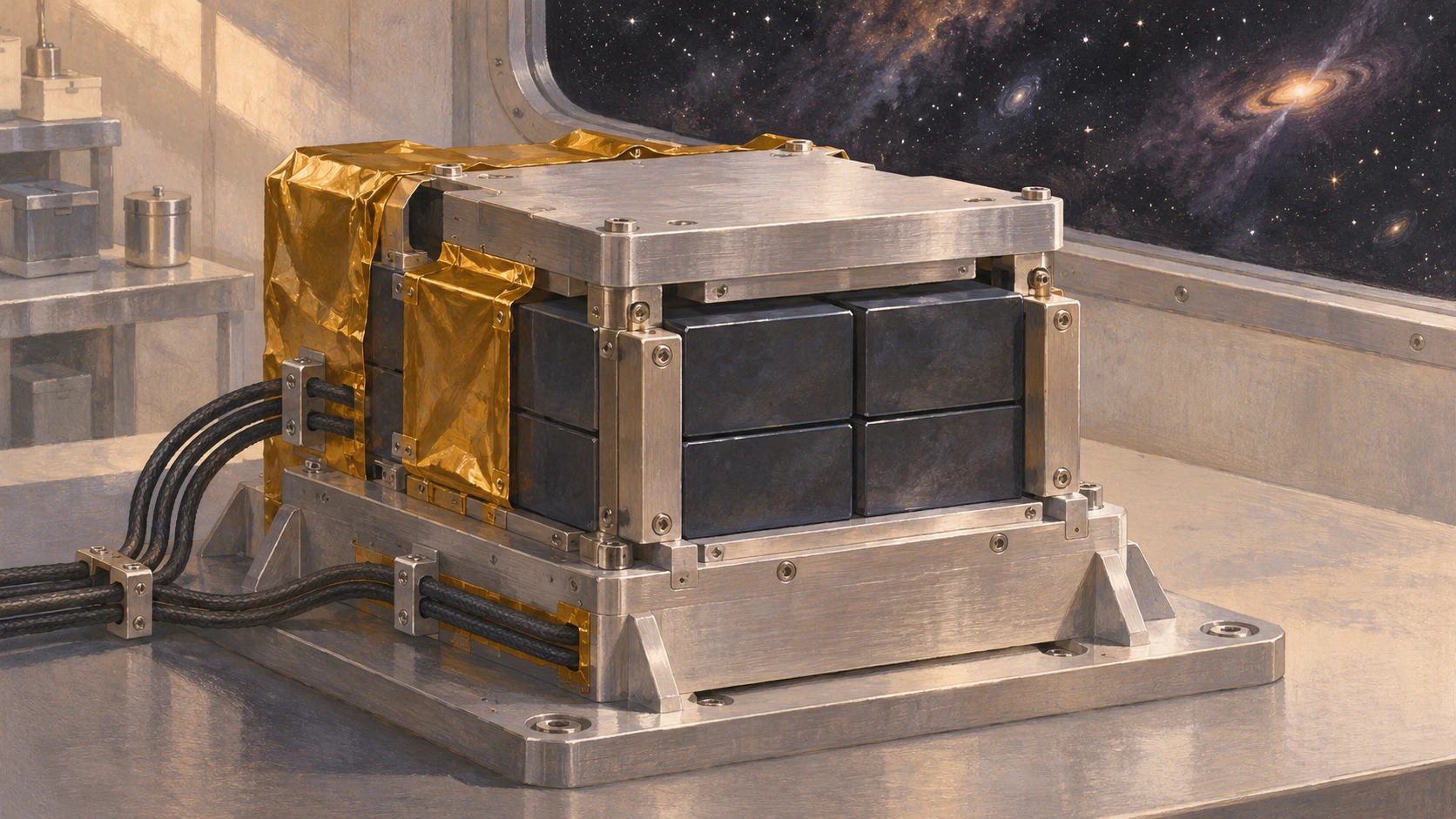
NASA’s next gamma-ray telescope has reached a new stage on its path to space. The scientific payload for COSI arrived at Northrop Grumman’s satellite facility in Sterling, Virginia, earlier this month, NASA reported November 16, moving the mission toward spacecraft assembly and testing ahead of a planned August 2027 launch.
The instrument was assembled over the summer at the University of California, Berkeley’s Space Sciences Laboratory. Engineers will attach it to a LEOStar-2 spacecraft, the platform that will carry the telescope. The delivery advances preparations for a mission designed to investigate some of the universe’s most energetic processes.
Primary sourceNASA: “NASA Payload to Study Gamma Rays Arrives at Northrop Grumman”The telescope will also look for signatures of newly formed elements. Different radioactive isotopes produce recognizable gamma-ray signals, allowing researchers to study the evolution of massive stars and the supernova explosions that end their lives. Its planned observing range stretches from 0.2 to 5 million electron volts.
Another goal is to locate brief gamma-ray bursts quickly enough for other telescopes to follow them. Combining light with other signals, including gravitational waves, can give researchers complementary views of the same event. These are proposed investigations; the arriving instrument has yet to produce observations from orbit.
The detection method is described in NASA’s technical mission profile. COSI tracks where gamma rays interact inside its detectors and how much energy they deposit. Those interactions constrain a photon’s possible origin to a circle on the sky. Overlapping circles from many photons help locate the source.
Sixteen germanium detectors form the instrument’s three-dimensional sensing volume, with surrounding detectors helping reject unwanted signals. A mechanical cooler keeps the germanium cold without consuming a stored cooling fluid. The arrangement is designed to gather both energy and position information, rather than produce a conventional optical photograph.
A predecessor instrument flew from New Zealand on a scientific balloon for 46 days in 2016. The satellite version is designed for a two-year mission, with a survey mode that can cover the whole sky each day. That repeated coverage should help researchers build maps while watching for short-lived events.
What’s next
Before any of that observing begins, the spacecraft and payload must pass vibration and thermal testing. NASA identifies those tests and installation as the next steps toward the August 2027 launch target.
End of story