


NASA aligns Roman’s instruments as the telescope prepares for science
A commissioning milestone improves pointing and stability, with further starlight-control work planned for its planet-imaging instrument.
How this story was made
This story was written with AI assistance from NASA’s source documents. Its figures and quotations were checked against their sources, and Digitalage Desk reviewed and approved it before publication. It is published under the name of Peter Michaels, Editor.
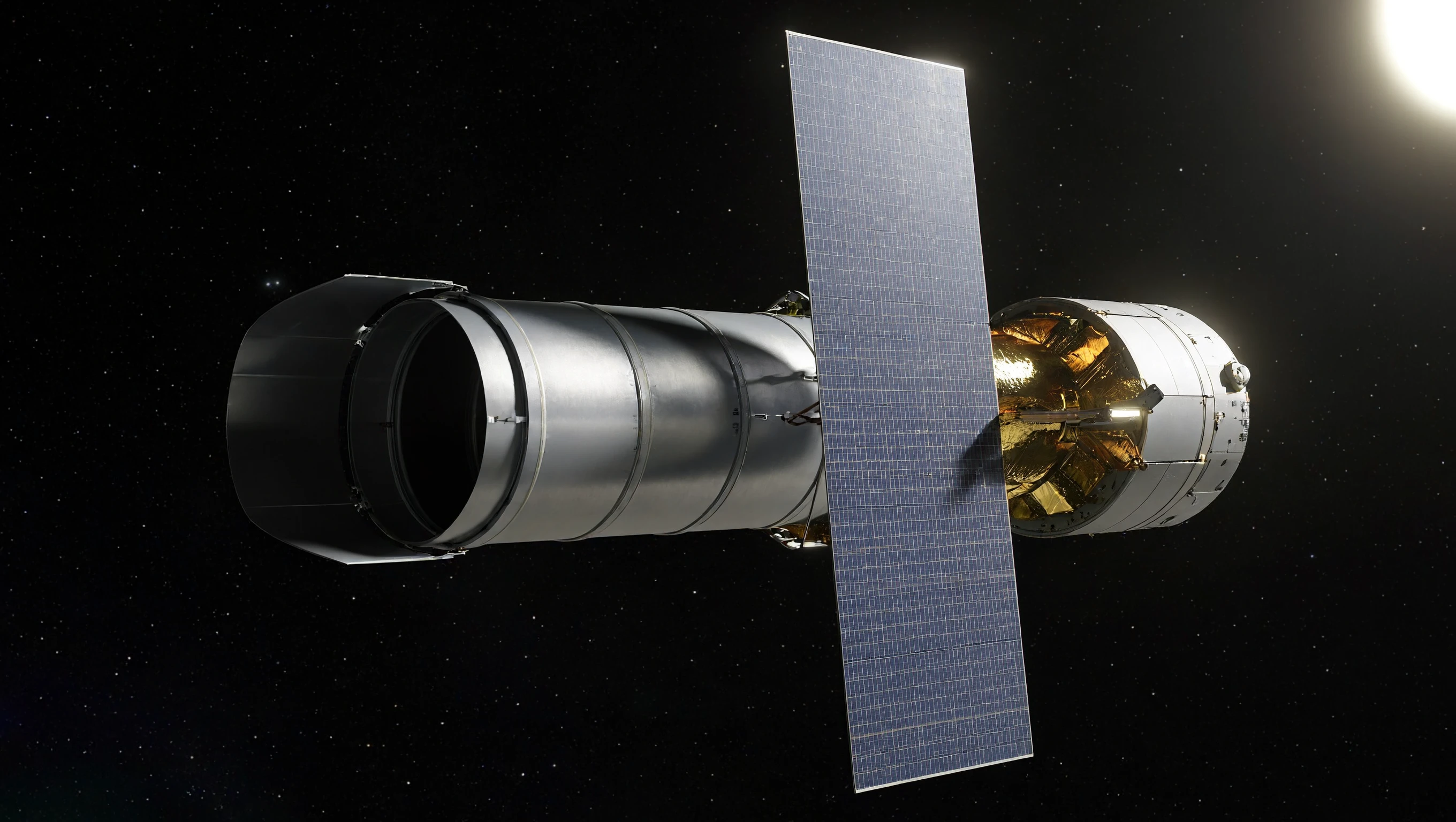
NASA’s Nancy Grace Roman Space Telescope has completed an instrument-alignment milestone, moving closer to science operations that will survey broad stretches of sky and test technology for imaging planets around other stars. The agency reported the progress on November 13.
Although the optics were aligned before launch, vibration, temperature changes and weightlessness can cause small shifts. The team compared stars’ measured positions with their expected locations, updating the observatory’s internal map so it can point accurately and remain steady while collecting light. Small positioning errors matter when extremely faint targets are the goal.
The work follows Roman’s entry into science commissioning on October 22. At that stage, NASA said the observatory could guide, take exposures, move between targets and transmit data. The next emphasis was the finer detail of image quality, after the broader systems checkout.
Roman’s Wide Field Instrument is designed to capture a patch of sky larger than the Moon’s apparent size. NASA says its field is about 200 times the area of Hubble’s infrared images from Wide Field Camera 3, allowing researchers to survey large regions with fewer separate exposures.
The instrument’s 18 detectors turn incoming starlight into electrical signals that become images. Its infrared observations are intended to explore planetary systems and the distribution of matter across the cosmos, while helping researchers investigate dark energy. Those are scientific objectives for the observing program, beyond the alignment work itself.
Roman also carries a Coronagraph Instrument that uses masks and flexible mirrors to suppress a star’s glare so nearby planets and dusty disks can become visible. The mirrors change shape to correct tiny optical errors. The instrument is intended to demonstrate direct-imaging technologies in space.
For the coronagraph, the team adjusted the secondary mirror, a connecting mirror and the instrument’s masks and optics. NASA says the next step will exercise more than 3,000 moving components that shape its deformable mirrors, preparing for more advanced control of real starlight in space.
Primary sourceNASA: “Instruments on NASA's Roman Space Telescope Get in Sync for Science”End of story