


ESA selects seven-spacecraft mission to probe Earth’s magnetic shield
Plasma Observatory would measure small and large changes together, with launch provisionally targeted for the late 2030s.
How this story was made
This story was written with AI assistance from European Space Agency’s source documents. Its figures and quotations were checked against their sources, and Digitalage Desk reviewed and approved it before publication. It is published under the name of Peter Michaels, Editor.
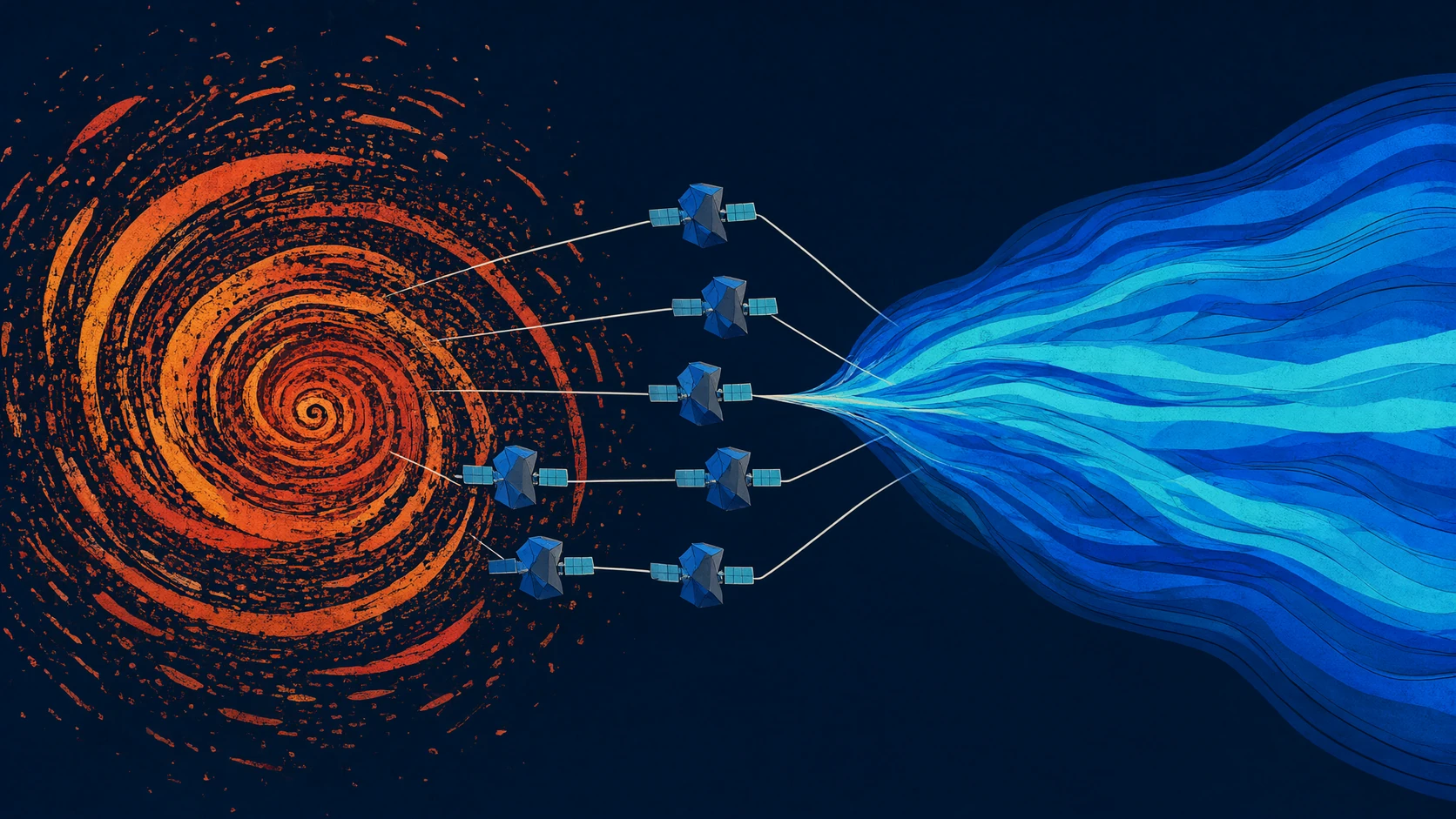
European Space Agency member states have selected Plasma Observatory, a planned seven-spacecraft mission that would investigate how energy moves through Earth’s magnetic environment.
The November 19 decision advances the project toward formal mission adoption and construction. ESA provisionally foresees a launch in the late 2030s.
Primary sourceEuropean Space Agency: “Seven-spacecraft observatory to study plasma universe”A nearby laboratory for space physics
The magnetosphere’s structure reflects Earth’s encounter with the solar wind, the flow of charged particles streaming from the Sun. On the sunward side, a bow shock slows and deflects that flow. Behind Earth, magnetic field lines extend into a long tail.
Between the shock and the boundary of Earth’s magnetic field lies a turbulent region containing disturbed solar-wind particles. Near the poles, openings allow some particles to enter the atmosphere and help create auroras.
Earth’s surroundings offer a nearby laboratory for processes that occur elsewhere in space. Plasma Observatory would investigate plasma, a gas of charged particles that responds to electric and magnetic fields.
Building on four-spacecraft observations
ESA’s earlier Cluster mission used four spacecraft launched in 2000. Their pyramid-shaped formation let scientists examine the same region from several positions, while adjustable spacing supported different scientific objectives.
When the satellites flew close together, they could investigate fine magnetic structures. Wider spacing provided a broader view of activity. Their observations helped map Earth’s magnetic environment in three dimensions and improve understanding of space weather, which can affect electronic equipment in orbit and on the ground.
Plasma Observatory aims to take that approach further. ESA says Cluster could examine one spatial and time scale at once; the new formation is designed to connect processes across scales simultaneously.
The selection follows a competition that began with a call for proposals in 2021. Further development lies ahead before the seven spacecraft can begin those measurements.
End of story