


Astronomers trace how a giant star swallowed its smaller companion
A newly published study combines years of telescope observations to reconstruct a stellar merger in the Andromeda galaxy.
How this story was made
This story was written with AI assistance from Nature’s source documents. Its figures and quotations were checked against their sources, and Digitalage Desk reviewed and approved it before publication. It is published under the name of Peter Michaels, Editor.
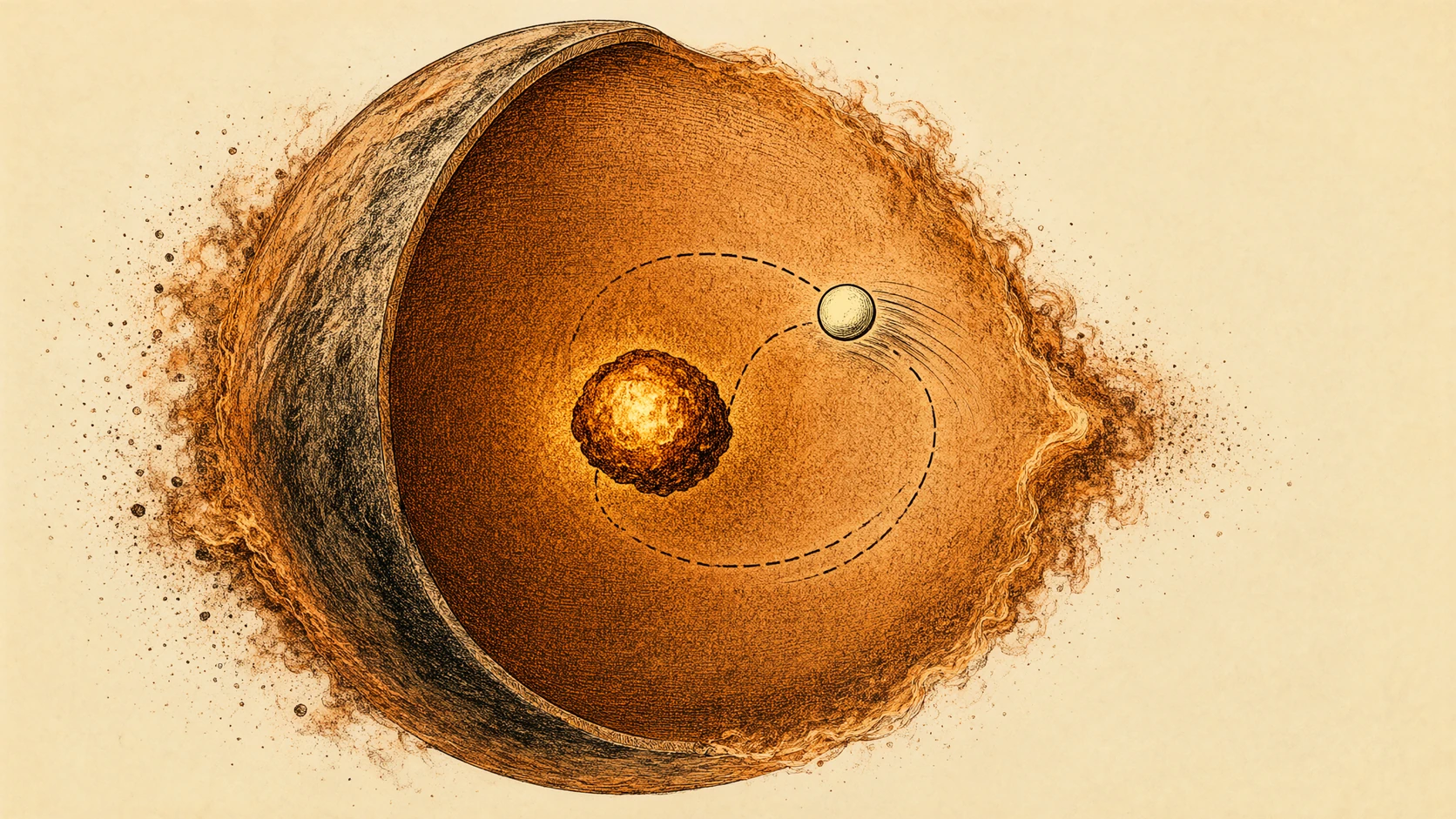
Astronomers have reconstructed how a small star spiraled inside an aging giant and merged with it, using observations made before, during and after an eruption seen in the Andromeda galaxy.
The study, published November 18 in Nature, connects seven years of gradual brightening with the eventual merger. The researchers conclude that friction inside the giant’s outer layers drained energy from its companion’s orbit, drawing the smaller star inward.
The system, formally designated AT 2025abao and nicknamed Bao, lies about 2.5 million light-years away. The eruption was observed in 2025; the new publication explains the evidence assembled around that event.
A warning in years of telescope data
According to NASA’s account of the observing campaign, researchers noticed unusual behavior in NEOWISE infrared data in February 2023. Earlier observations showed that the source had remained at a consistent brightness from 1989 to 2018 before it began to brighten.
The team continued monitoring. Observations in September 2024 showed increasing brightness and dust production. In July 2025, NASA’s SPHEREx mission observed the object brightening in infrared light.
The Zwicky Transient Facility detected the eruption on October 17, 2025. The James Webb Space Telescope observed Bao on December 24, providing infrared measurements of the surrounding dust. Other space and ground-based telescopes supplied further observations, helping build a record across ultraviolet, visible and infrared wavelengths.
Reconstructing the stars’ final encounter
The researchers used those measurements and computer models to estimate the stars’ properties and explain the outburst. Their analysis points to a giant with roughly seven times the Sun’s mass and a companion with about 0.7 times the Sun’s mass.
This interaction is called common envelope evolution: both stars occupy gas belonging to the expanded outer layers of the larger star. The study concludes that the smaller companion ultimately reached the giant’s core, with the merger driving material outward.
Primary sourceNature: “Nature: s41586 026 11221 z”Bao provides a detailed example grounded in observations spanning the event, with the stars’ masses and internal interaction reconstructed through modeling. Further observations are needed to establish how the surviving merged star settles.
End of story